In a landmark announcement from NASA headquarters, Administrator Jared Isaacman has set a bold new course for American space exploration. Beyond confirming plans for regular moon missions and a lunar base, the agency revealed its most ambitious project yet: building and launching the first-ever nuclear reactor-powered interplanetary spacecraft, named the Space Reactor-1 Freedom (SR-1), with a target Mars arrival by the end of 2028.nnThis announcement marks a pivotal shift from decades of theoretical studies and ground-based concepts to tangible hardware destined for deep space. A successful mission would not only represent a monumental engineering achievement but could fundamentally alter the economics and timelines of human exploration, potentially giving the United States a critical advantage in the new space race with China. While experts acknowledge the timeline is exceptionally aggressive, the prospect has electrified the aerospace and nuclear communities.nn## Why Nuclear Propulsion is a Game-ChangernnTo understand why SR-1 is so significant, we need to look at the limitations of our current spaceflight technology. For over 60 years, chemical propulsion has been the workhorse of rocketry. It works by mixing and igniting fuels like liquid hydrogen and oxygen, creating a hot exhaust that is expelled to generate thrust.nn> “Chemical propulsion offers tremendous thrust for escaping Earth’s gravity, but it’s incredibly inefficient for the long haul across the solar system,” explains Simon Middleburgh, co-director of the Nuclear Futures Institute at Bangor University.nnThis is where nuclear thermal propulsion (NTP) comes in. Think of it as a massive, super-efficient engine for space. Instead of burning chemical fuel, it uses a nuclear reactor to heat a propellant like liquid hydrogen to extreme temperatures. This super-heated gas is then expelled through a nozzle to create thrust.nnThe key advantage is energy density. A nuclear fuel source packs millions of times more energy per kilogram than conventional rocket fuel.nn”You get more bang per kilogram,” says Middleburgh. “It’s really, really, high efficiency,” adds Lindsey Holmes, a space nuclear technology expert. This efficiency translates directly into faster transit times and greater mission flexibility.nn## Solving the Deep-Space Power ProblemnnNuclear propulsion also solves another critical challenge: power generation far from the Sun. Most current spacecraft, including the Orion capsule used in the Artemis missions, rely on solar panels. This works well in the inner solar system but becomes problematic as you travel farther out.nn Intermittent Power: Planets and moons cast shadows, creating periods of darkness where solar power is unavailable.n Diminished Sunlight: Beyond Mars, sunlight becomes too weak for solar panels to operate effectively.nnNuclear systems provide a constant, reliable power source regardless of location or orientation. We’ve used small-scale nuclear power in space before—in the form of Radioisotope Thermoelectric Generators (RTGs) on missions like Voyager and Cassini. These devices use the heat from decaying plutonium to generate electricity. SR-1 represents a massive scale-up from these battery-like units to a full-fledged, reactor-based propulsion and power system.nn## The SR-1 Freedom: Mission Profile and Potential ImpactnnWhile specific technical details of SR-1 remain under wraps, the stated goal is an uncrewed test flight to Mars. The 2028 timeline is audacious, requiring NASA and its industry partners to design, build, test, and launch a completely novel spacecraft system in just a few years.nnIf successful, the implications are profound:nn1. Faster Transit to Mars: Current estimates suggest a nuclear-powered spacecraft could reduce travel time to Mars from 6-9 months (with chemical propulsion) to as little as 3-4 months. This drastically reduces astronauts’ exposure to deep-space radiation and microgravity.n2. Greater Mission Flexibility: The high efficiency means spacecraft can carry more cargo or make course corrections without crippling fuel penalties. This enables more complex orbital maneuvers and even abort scenarios.n3. Enabling the Outer Solar System: Nuclear propulsion and power are considered essential for sustained exploration of the outer planets—Jupiter’s moons, Saturn, and beyond—where solar power is negligible.n4. Geopolitical Momentum: A successful demonstration would cement U.S. leadership in advanced space technology, a key arena in its strategic competition with China.nn## The Challenges on the Path to LaunchnnThe road to launching SR-1 is paved with significant technical and regulatory hurdles:nn Engineering & Safety: Building a compact, space-worthy nuclear reactor that can withstand launch vibrations, the vacuum of space, and extreme temperature swings is a monumental challenge. The system must be impeccably safe, with multiple layers of containment to prevent any release of radioactive material, especially during launch.n Heat Management: A space reactor generates immense heat that must be dissipated in an environment without air for convection. This will require advanced radiator systems.n Propellant Handling: The likely propellant, liquid hydrogen, must be stored at cryogenic temperatures for months during the cruise to Mars, another major engineering feat.n Public and International Policy: Launching a nuclear reactor into space will require navigating a complex web of safety reviews, environmental impact assessments, and international treaties. Clear public communication will be vital to address safety concerns.nn## The Future Powered by AtomsnnNASA’s SR-1 Freedom mission is more than a single spacecraft; it’s the opening gambit in a new chapter of exploration. By proving the viability of nuclear thermal propulsion, NASA aims to unlock the solar system. The technology could one day power:nn Fast-transit crewed missions to Mars.n Heavy cargo haulers for lunar and Martian bases.n Rapid-response probes to intercept interstellar objects.n Orbital tugs that can reposition satellites or clean up space debris.nnThe announcement of SR-1 signals a decisive move from the drawing board to the launch pad. While the 2028 deadline will test the limits of aerospace engineering, the potential reward—a faster, more capable pathway to the planets—is a vision worth pursuing. The success of this mission could define space exploration for the rest of the 21st century, turning science fiction into operational reality.
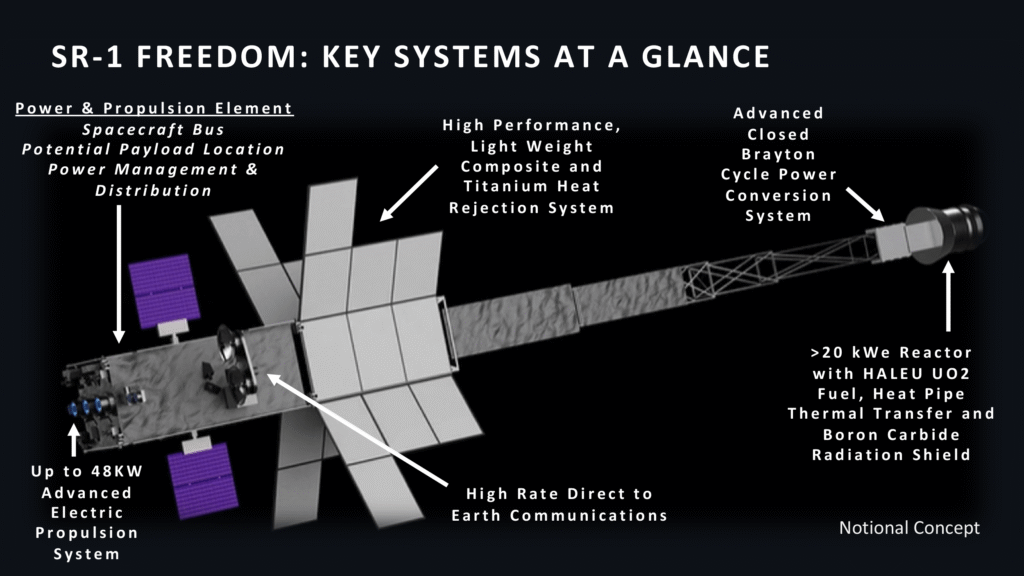
NASA’s SR-1 Freedom: How Nuclear Propulsion Will Revolutionize Interplanetary Travel

2
0
0
Comments (0)
Login Log in to comment.
Be the first to comment!